
applied daoist arts
Long-Distance Treatments
-

The Method
Long-distance treatments guide the body and mind into a state of deep organization — sometimes called the prenatal or original state — where the system’s innate intelligence can re-establish balance and coherence.
This work supports recovery from physical depletion, emotional fatigue, and energetic imbalance. It is also beneficial for individuals seeking profound renewal or spiritual realignment within the rhythms of life.
How to Prepare
Choose a quiet, comfortable space free from interruptions.
Sit or lie down with relaxed awareness; soft instrumental music or low lighting can help settle the mind.
Allow sensations such as warmth, pulsing, tingling, or emotional release to arise naturally.
Afterward, rest, hydrate, and observe the subtle shifts that unfold in the following days as your system continues to integrate the work.
“Organization is not imposed — it emerges when stillness is allowed to do its work.”
-

Individual Sessions
Structure:
Consultation: a brief phone conversation to clarify health concerns and intention.
Treatment: you rest quietly in your own space while the practitioner works within the Qi field to support systemic reorganization.
Follow-Up: a short conversation afterward to discuss experiences and next steps.
Each session lasts about one hour and offers a dedicated time for stillness, recalibration, and renewal.
Clients often describe a sense of clarity, centeredness, and subtle vitality in the hours and days that follow.
“The field of Qi organizes itself when given attention and space.”
-

Group Sessions
Group treatments are available through a monthly subscription, providing weekly sessions on a scheduled day. Before each session, participant information is reviewed to attune the field to the group’s current needs.
During treatment, a synergistic resonance emerges — amplifying the effects of reorganization and fostering a shared sense of calm and vitality.
Participants frequently report deeper sleep, emotional steadiness, and an increased feeling of connection to others and to the natural world.
Yi Jing Consultations
Purpose & Approach
Areas of Inquiry
Consultation Format
Preparation
Perceiving the movement of change through the wisdom of the Book of Changes.
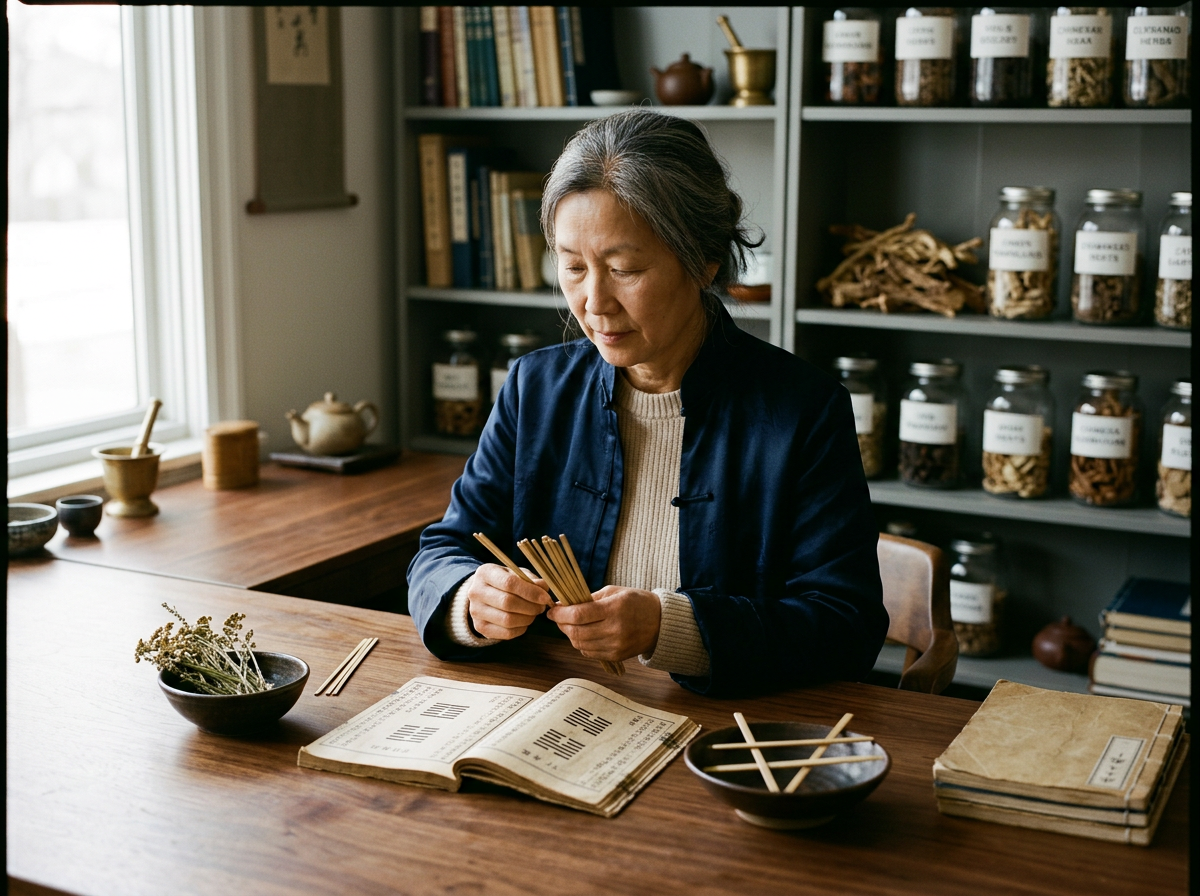
The Yi Jing (易經), or Book of Changes, is one of the foundational texts of Daoist thought and classical Chinese philosophy. It describes the continual transformation of life through the dynamic relationship of Yin (陰) and Yang (陽) — stillness and movement, receptivity and action, contraction and expansion.
An Yi Jing consultation is not fortune-telling, but a process of understanding the underlying patterns and conditions shaping a situation. By clarifying these dynamics, the consultation supports more thoughtful timing, clearer decision-making, and a more appropriate response to change. Rather than predicting fixed outcomes, the Yi Jing reveals how conditions are developing and where imbalance, opportunity, or transition may already be present.
The Yi Jing does not tell us what must happen; it reveals the nature of what is unfolding.
Consultations begin with a focused question or area of inquiry. Through the casting and interpretation of the resulting hexagram(s), the practitioner examines the energetic and symbolic patterns surrounding the situation.
Interpretation integrates:
classical Daoist principles
the movement of Yin and Yang
timing and relationship between conditions
practical reflection and application
The process encourages clarity rather than dependency, helping individuals understand how to move in greater alignment with present circumstances.
To understand change is to respond to it with greater awareness.
Yi Jing consultations may support insight into:
Life transitions and direction
Relationships and family dynamics
Professional or creative decisions
Periods of uncertainty or stagnation
Questions of timing, balance, and personal development
The consultation does not replace personal responsibility or practical action; rather, it helps illuminate the broader context within which action takes place.
Clarifying the Question — identifying the central issue or pattern
Casting the Yi Jing — generating the hexagram(s)
Interpretation & Dialogue — exploring the meaning and practical implications
Reflection & Integration — considering how the insight applies moving forward
Sessions are available remotely or in person when appropriate.
Written notes or summaries may also be provided upon request.
Before the consultation, take a few quiet moments to reflect on the deeper nature of the question being asked. Clear questions tend to produce clearer insight.
Afterward, many people find it helpful to sit with the imagery and themes that emerged rather than rushing immediately toward conclusions. Often the meaning deepens over time as events continue to unfold.
The wisdom of the Yi Jing emerges through observation, reflection, and relationship with change itself.

Perceiving the movement of change through the wisdom of the Book of Changes.
The Yi Jing (易經), or Book of Changes, is one of the foundational texts of Daoist thought and classical Chinese philosophy.
It describes the continual transformation of life through the dynamic relationship of Yin (陰) and Yang (陽) — stillness and movement, receptivity and action, contraction and expansion.
A Yi Jing consultation is not fortune-telling, but a process of understanding the underlying patterns and conditions shaping a situation. By clarifying these dynamics, the consultation supports more thoughtful timing, clearer decision-making, and a more appropriate response to change.
Rather than predicting fixed outcomes, the Yi Jing reveals how conditions are developing and where imbalance, opportunity, or transition may already be present.
The Yi Jing does not tell us what must happen; it reveals the nature of what is unfolding.
Purpose & Approach
Consultations begin with a focused question or area of inquiry. Through the casting and interpretation of the resulting hexagram(s), the practitioner examines the energetic and symbolic patterns surrounding the situation.
Interpretation integrates:
classical Daoist principles
the movement of Yin and Yang
timing and relationship between conditions
practical reflection and application
The process encourages clarity rather than dependency, helping individuals understand how to move in greater alignment with present circumstances.
To understand change is to respond to it with greater awareness.
Areas of Inquiry
Yi Jing consultations may support insight into:
Life transitions and direction
Relationships and family dynamics
Professional or creative decisions
Periods of uncertainty or stagnation
Questions of timing, balance, and personal development
The consultation does not replace personal responsibility or practical action; rather, it helps illuminate the broader context within which action takes place.
Consultation Format
Clarifying the Question — identifying the central issue or pattern
Casting the Yi Jing — generating the hexagram(s)
Interpretation & Dialogue — exploring the meaning and practical implications
Reflection & Integration — considering how the insight applies moving forward
Sessions are available remotely or in person when appropriate.
Written notes or summaries may also be provided upon request.
Preparation
Before the consultation, take a few quiet moments to reflect on the deeper nature of the question being asked. Clear questions tend to produce clearer insight.
Afterward, many people find it helpful to sit with the imagery and themes that emerged rather than rushing immediately toward conclusions. Often the meaning deepens over time as events continue to unfold.
The wisdom of the Yi Jing emerges through observation, reflection, and relationship with change itself.
BlessingsBig Ideas, Real Impact.
Awareness, intention, and the wisdom to move with the energies of change.
01
Intentional
Structure
02
Collaborative
Energy
03
Expert
Facilitation